"'Very true,' said Henry, 'and this is a very nice day; and we are taking a very nice walk; and you are two very nice young ladies. Oh, it is a very nice word, indeed! - it does for everything. Originally, perhaps, it was applied only to express neatness, propriety, delicacy, or refinement; - people were nice in their dresss, in their sentiments, or their choice. But now every commendation on every subject is comprised in that one word.'"
From Northanger Abbey by Jane Austen

Showing posts with label fiction. Show all posts
Showing posts with label fiction. Show all posts
Sunday, November 24, 2013

Tuesday, October 22, 2013
Some Reading

The old reading mojo is in full force. I enjoyed late summer days reading Dan Brown's The Lost Symbol, where
Then I ploughed through Anne Rice's Cry to Heaven, an epic account of the lives of two castrati. I was caught up in the fantastic detail and compelling portraits of two very different men, whose lives intertwine. I came to care for these characters so much.
The Picture of Dorian Grey was a sort of one-off book club project for the cottage trip. We all read it. We discussed it. I think the feelings were mutual. The purple prose, the epigram-laden pages, became a bit too much. What I loved in the brief but sentimental stories by Wilde that I read as a child, don't translate so well for me as an adult.
Now, it's Jane Austen time, as I'm reading not only all six novels, but some supporting material too.
Friday, October 18, 2013
The One-Off, Six-Meeting, Limited-Edition Jane Austen Book Club of Toronto
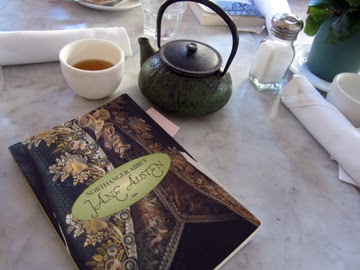
This summer, I was surprised to realize that I'd never actually read a Jane Austen novel. I've seen so many filmed versions, and have a beautiful set of the novels that my dad gave me years ago, so I was quite certain this wasn't the case.
Okay, it's the case. Inspired by this book, I sent out the word to a few friends, and then, with some friends of friends along for the ride, started the Jane Austen Book Club! It's a temporary feature as we'll read all six novels, one every two months, giving us a year of Austen pleasure and conversation.
Our first meeting was last Saturday, at L'Espresso Bar Mercurio. There are nine of us in all, so there's lots of opinions to be shared. The novel was Northanger Abbey and I think it can be universally acknowledged to be the slightest of her six complete novels. I was amazed at how very witty Austen is, and how very observant as to the ways of people, especially - in this case - young women. A few days before our meeting I was standing in line at Tim Horton's and I overheard two teenage girls talking. It was all very "OMG I can't believe she said that to him. I swear to God I was going to die. There's no fucking way, and... no I mean it - OMG totally." Etc. It was just like Catherine and Isabella... nothing has changed. Teenage girls will still swing madly from extreme to extreme, dying one minute, in ecstacy the next. I remember it, and I just love how Jane Austen captured it. One of the party had even read Mysteries of Udolpho by Ann Radcliffe, the gothic thriller that inspired Jane Austen and her heroine's vivid imagination. And now we're onto hopefully more intriguing material with Sense and Sensibility.
Tuesday, October 15, 2013
Peter Grimes and Silas Marner
"Eh, my precious child, the blessing was mine. If you hadn't been sent to save me, I should ha' gone to the grave in my misery."
From Silas Marner by George Eliot
"I've seen in stars the life that we might share:
Fruit in the garden, children by the shore,
A fair white doorstep, and a woman's care.
But dreaming builds what dreaming can disown."
From the libretto of Benjamin Britten's Peter Grimes by Montagu Slater, based on a part of George Crabbe's poem, The Borough
I did two things recently: I read George Eliot's novel Silas Marner and I saw a performance of Benjamin Britten's Peter Grimes.
What can I say about George Eliot, but that she is one of my favourite authors, for her expressiveness, her understanding of the human spirit, and for her gentle wit and unhurried story telling.
Peter Grimes is not my favourite opera, but I love Benjamin Britten's music and this production, directed by the brilliant Neil Armfield, starred Ben Heppner as Grimes, in a truly great performance, presented by the Canadian Opera Company through the month of October (yes, you can still catch this excellent production!).
It got me thinking about the protagonists, Grimes and Marner. They're similar in many ways. Both men are embittered loners, haunted by wrongs done to them, isolated and full of anger. Both have a female character nearby who wishes to reach out and help. Into each of their lives comes a child. From here in the stories differ greatly.
///SPOILER ALERTS!///
Grimes the fisherman has had one boy apprentice die in his care. He takes another from the workhouse. Ellen, the schoolteacher, yearns to help him care for the child, and both dream of making a family together. But Peter cannot consider it until he has made his fortune, and so, he drives himself and his young charge relentlessly. Ellen, seeking to bring some tenderness into both his life and that of the boy, tries to persuade him to ease up on the child, to treat him... as a child. Grimes won't have it, and strikes her angrily. The villagers, already suspicious and angry, set out to hunt him down. He unwisely chooses to go out fishing once more with his apprentice, and the boy dies in an accident. Well... and please forgive my glibness as well as my paraphrasing... but to lose one apprentice may be regarded as a misfortune; to lose two is unacceptable. Grimes is persuaded to take a small boat out to sea and sink it before the mob gets to him. There are glimpses in him of potential tenderness, reflections of how Ellen has treated the boy, but in his growing madness I can't help but wonder at where everything went horribly wrong. How a small, underfed, unloved workhouse child can fail to melt a heart is a mystery to most of us. Grimes is a rough brute, but also a victim. His final action truly does feel like the only course left open to him.
For Silas Marner, embittered and driven also to make a fortune, weaving is his whole life. Short-sighted and bent-over, he works tirelessly at his loom, slowly amassing a pile of gold which he keeps hidden in his cottage. It's stolen from him by an unseen thief. Silas's grief is primal. All he's lived for his miserly life is gone. But not long after - to make a long story short - he finds a baby girl who has toddled into his cottage on a winter's night. Her mother has died, and Silas, at first bewildered by the baby's golden curls, sees her, in his almost-blind way, as a replacement for his lost gold. But Eppie, as he calls her, is much more precious than that. And with the kind friendship of a married neighbour, Dolly Winthrop, he raises Eppie with all the devotion a natural parent could give, as she raises him from that twisted, lonely life, to a love-filled existence. It's such a heart-warming story. There are twists and turns I won't go into here, but it has a happy ending, the very best.
Is Silas Marner more idealistic and romanticized than Peter Grimes? Absolutely. They are very different takes on the human condition, and both worth embracing and considering. It's my very good fortune to have experienced both.
From Silas Marner by George Eliot
"I've seen in stars the life that we might share:
Fruit in the garden, children by the shore,
A fair white doorstep, and a woman's care.
But dreaming builds what dreaming can disown."
From the libretto of Benjamin Britten's Peter Grimes by Montagu Slater, based on a part of George Crabbe's poem, The Borough
I did two things recently: I read George Eliot's novel Silas Marner and I saw a performance of Benjamin Britten's Peter Grimes.
What can I say about George Eliot, but that she is one of my favourite authors, for her expressiveness, her understanding of the human spirit, and for her gentle wit and unhurried story telling.
Peter Grimes is not my favourite opera, but I love Benjamin Britten's music and this production, directed by the brilliant Neil Armfield, starred Ben Heppner as Grimes, in a truly great performance, presented by the Canadian Opera Company through the month of October (yes, you can still catch this excellent production!).
It got me thinking about the protagonists, Grimes and Marner. They're similar in many ways. Both men are embittered loners, haunted by wrongs done to them, isolated and full of anger. Both have a female character nearby who wishes to reach out and help. Into each of their lives comes a child. From here in the stories differ greatly.
///SPOILER ALERTS!///
Grimes the fisherman has had one boy apprentice die in his care. He takes another from the workhouse. Ellen, the schoolteacher, yearns to help him care for the child, and both dream of making a family together. But Peter cannot consider it until he has made his fortune, and so, he drives himself and his young charge relentlessly. Ellen, seeking to bring some tenderness into both his life and that of the boy, tries to persuade him to ease up on the child, to treat him... as a child. Grimes won't have it, and strikes her angrily. The villagers, already suspicious and angry, set out to hunt him down. He unwisely chooses to go out fishing once more with his apprentice, and the boy dies in an accident. Well... and please forgive my glibness as well as my paraphrasing... but to lose one apprentice may be regarded as a misfortune; to lose two is unacceptable. Grimes is persuaded to take a small boat out to sea and sink it before the mob gets to him. There are glimpses in him of potential tenderness, reflections of how Ellen has treated the boy, but in his growing madness I can't help but wonder at where everything went horribly wrong. How a small, underfed, unloved workhouse child can fail to melt a heart is a mystery to most of us. Grimes is a rough brute, but also a victim. His final action truly does feel like the only course left open to him.
For Silas Marner, embittered and driven also to make a fortune, weaving is his whole life. Short-sighted and bent-over, he works tirelessly at his loom, slowly amassing a pile of gold which he keeps hidden in his cottage. It's stolen from him by an unseen thief. Silas's grief is primal. All he's lived for his miserly life is gone. But not long after - to make a long story short - he finds a baby girl who has toddled into his cottage on a winter's night. Her mother has died, and Silas, at first bewildered by the baby's golden curls, sees her, in his almost-blind way, as a replacement for his lost gold. But Eppie, as he calls her, is much more precious than that. And with the kind friendship of a married neighbour, Dolly Winthrop, he raises Eppie with all the devotion a natural parent could give, as she raises him from that twisted, lonely life, to a love-filled existence. It's such a heart-warming story. There are twists and turns I won't go into here, but it has a happy ending, the very best.
Is Silas Marner more idealistic and romanticized than Peter Grimes? Absolutely. They are very different takes on the human condition, and both worth embracing and considering. It's my very good fortune to have experienced both.
Sunday, July 7, 2013
Quote of the Day
"A solitary, unused to speaking of what he sees and feels, has mental experiences which are at once more intense and less articulate than those of a gregarious man. They are sluggish, yet more wayward, and never without a melancholy tinge. Sights and impressions which others brush aside with a glance, a light comment, a smile, occupy him more than their due; they sink silently in, they take on meaning, they become experience, emotion, adventure. Solitude gives birth to the original in us, to beauty unfamiliar and perilous - to poetry. But also, it gives birth to the opposite: to the perverse, the illicit, the absurd."
From Death in Venice by Thomas Mann (translation by Helen Tracey Lowe-Porter)
From Death in Venice by Thomas Mann (translation by Helen Tracey Lowe-Porter)
Sunday, June 23, 2013
Okay, Now I'm Scaring Myself
It's a theory not universally considered (well, really just by me) that once I was going to start reading again, I wouldn't stop.
Last November, in another attempt to read a complete book, I started The Jane Austen Book Club by Karen Joy Fowler. I was on a train. I was full of good intentions (never a good sign). I didn't get past the first couple of pages.
Last Friday, also on a train, I finished the book... that I had started MERE DAYS PREVIOUSLY.
*seated dance of mojo-reclaiming triumph*
What has also returned to me, along with the ability to read an entire book, is a sense of relaxation, an ability to be constructively lazy. I think Tom Hodgkinson (secret boyfriend numero uno) would be proud. I like to think he would.
As for the book, it's a tender, delicious read, and I imagine it would be very enjoyable to those who haven't read Jane Austen (or at least seen the movies). But if you have, the threads that tie the book club members to Austen's tales are well woven and fun to recognize. I saw bits of the movie on television one night, and I suppose the most noticeable difference is that the characters are much younger in the movie than the book. Oh, there's a shocker.
*middle-aged smirk*

Last November, in another attempt to read a complete book, I started The Jane Austen Book Club by Karen Joy Fowler. I was on a train. I was full of good intentions (never a good sign). I didn't get past the first couple of pages.
Last Friday, also on a train, I finished the book... that I had started MERE DAYS PREVIOUSLY.
*seated dance of mojo-reclaiming triumph*
What has also returned to me, along with the ability to read an entire book, is a sense of relaxation, an ability to be constructively lazy. I think Tom Hodgkinson (secret boyfriend numero uno) would be proud. I like to think he would.
As for the book, it's a tender, delicious read, and I imagine it would be very enjoyable to those who haven't read Jane Austen (or at least seen the movies). But if you have, the threads that tie the book club members to Austen's tales are well woven and fun to recognize. I saw bits of the movie on television one night, and I suppose the most noticeable difference is that the characters are much younger in the movie than the book. Oh, there's a shocker.
*middle-aged smirk*

Thursday, June 13, 2013
BPG, Proud Reader
Still basking in the return of my reading mojo, I took a bit longer than a couple of days to finish Her Fearful Symmetry, by Audrey Niffenegger (The Time-Traveler's Wife).
The book started out with great promise. Grief, ghosts, and a slew of unexpected characters.
///SPOILER ALERT!!!///
Elspeth, a middle-aged woman, dies leaving her downstairs grief-stricken younger lover, Robert, and an OCD-riddled upstairs neighbour, Martin. Her considerable estate is left to 20-year-old twins, her nieces whom she has never met. Her will states that they must live in her London flat for a year and that their mother (Elspeth's twin) must never step foot inside the flat. The nieces live in Chicago but are soon transplanted to the flat, which is part of an old rambling house on the edge of Highgate Cemetery.
oooOOOOooooOOOOOOOOOOooooooooo
Okay, that was my ghostly sound. Because, it isn't long before the ghost makes herself known. Can anyone guess who it is? Up til this point it's riveting, although the twin nieces are like the child from The Demon Seed, or something from an episode from the original Star Trek series: small, thin, with white-blonde hair, dressing often in all white or other babyish colours. They're a... tad creepy. But, they also resemble their mother and her twin sister. So of course it isn't long before Robert falls for one of them, Valentina.
That's where it all starts to unravel for me. Valentina's sister, Julia, is the dominant of the pair, and won't have Valentina doing anything on her own. The twins are so incapable of experiencing life separately that they've remained virgins, and are likely to stay in that condition indefinitely. Virgin-state aside, they are puerile in the extreme, almost incapable of adulthood, low-functioning, and - as previously stated - pretty dull. SUDDENLY... the other characters decide that Valentina is suicidal in her desperation to separate from her sister. I didn't get that idea at all. But.. SUDDENLY she is helped by her dead aunt's ghost to come up with a morbid plan. Her aunt will pull her soul out of her body and she will fall dead. Everyone will grieve. She will be buried in the family crypt (conveniently above ground). Then, her soul will be sort of squashed back into her slightly decomposed body (they experiment on a kitten first, with negative results) and - hey presto! - she can live, er, her own life. It seems a little extreme doesn't it? Yes, yes it does. Why not just get some therapy, buy a bus ticket, get the hell out of town, whatever?
What's more insane is that Robert goes along with the plot. So, this meek little girl, despite knowing the heartbreak she will cause her family, knowing she will be believed to be dead, won't be able to get a passport or get a drivers license, work or do anything which requires official identification, goes through with her crazy scheme... except it doesn't quite go to plan. Sigh. Her slightly decomposed body IS habited once more and comes to life. Can anyone guess who inhabits the body and runs off with Robert? BLIMEY.
Ohhhh, I so loved how this book started. Not so much how it ended. But Niffenegger remains a fantastically compelling author.
The book started out with great promise. Grief, ghosts, and a slew of unexpected characters.
///SPOILER ALERT!!!///
Elspeth, a middle-aged woman, dies leaving her downstairs grief-stricken younger lover, Robert, and an OCD-riddled upstairs neighbour, Martin. Her considerable estate is left to 20-year-old twins, her nieces whom she has never met. Her will states that they must live in her London flat for a year and that their mother (Elspeth's twin) must never step foot inside the flat. The nieces live in Chicago but are soon transplanted to the flat, which is part of an old rambling house on the edge of Highgate Cemetery.
oooOOOOooooOOOOOOOOOOooooooooo
Okay, that was my ghostly sound. Because, it isn't long before the ghost makes herself known. Can anyone guess who it is? Up til this point it's riveting, although the twin nieces are like the child from The Demon Seed, or something from an episode from the original Star Trek series: small, thin, with white-blonde hair, dressing often in all white or other babyish colours. They're a... tad creepy. But, they also resemble their mother and her twin sister. So of course it isn't long before Robert falls for one of them, Valentina.
That's where it all starts to unravel for me. Valentina's sister, Julia, is the dominant of the pair, and won't have Valentina doing anything on her own. The twins are so incapable of experiencing life separately that they've remained virgins, and are likely to stay in that condition indefinitely. Virgin-state aside, they are puerile in the extreme, almost incapable of adulthood, low-functioning, and - as previously stated - pretty dull. SUDDENLY... the other characters decide that Valentina is suicidal in her desperation to separate from her sister. I didn't get that idea at all. But.. SUDDENLY she is helped by her dead aunt's ghost to come up with a morbid plan. Her aunt will pull her soul out of her body and she will fall dead. Everyone will grieve. She will be buried in the family crypt (conveniently above ground). Then, her soul will be sort of squashed back into her slightly decomposed body (they experiment on a kitten first, with negative results) and - hey presto! - she can live, er, her own life. It seems a little extreme doesn't it? Yes, yes it does. Why not just get some therapy, buy a bus ticket, get the hell out of town, whatever?
What's more insane is that Robert goes along with the plot. So, this meek little girl, despite knowing the heartbreak she will cause her family, knowing she will be believed to be dead, won't be able to get a passport or get a drivers license, work or do anything which requires official identification, goes through with her crazy scheme... except it doesn't quite go to plan. Sigh. Her slightly decomposed body IS habited once more and comes to life. Can anyone guess who inhabits the body and runs off with Robert? BLIMEY.
Ohhhh, I so loved how this book started. Not so much how it ended. But Niffenegger remains a fantastically compelling author.
Wednesday, June 12, 2013
Quote of the Day
"What is more basic than the need to be known? It is the entirety of intimacy, the elixir of love, this knowing."
From Her Fearful Symmetry, by Audrey Niffenegger
From Her Fearful Symmetry, by Audrey Niffenegger
Thursday, May 23, 2013
It's Back!
I read a book!
I got my reading mojo back!
Okay, so what's the big deal? Well, for some reason, I stopped reading about a year ago. It happened the third time I tried reading Diana Gabaldon's An Echo in the Bone. I got about 200 pages in three times, and gave up. I've enjoyed the Outlander series very much, and have really cared about her wonderfully written characters, but at this point I think a strong editor should have done some hacking and hewing. This inability to finish a lengthy book unnerved me. Then I didn't want to read anything. I literally haven't completed a book in over a year, although there have been some false starts.
But a few weekends ago, with eight hours of train travel to sit through, I read one whole book. World War Z. Yep. A zombie apocalypse novel. But if that's what it took, that's what it took. And I enjoyed it! It's a zippy read, and you can see why it's spawning a movie, although I have it on good authority (thank you Mr. E.) that it probably doesn't follow the book too closely. I don't see a role in the book for Brad Pitt, but I'm sure the producers were all over fixing that little problem... one of whom is... Brad Pitt!
Last night I finished the Booker Prize-nominated The Unlikely Pilgrimage of Harold Fry, by actress/playwright/author (which makes her pretty darned amazing) Rachel Joyce. A retired man, numbed and dull in his lonely marriage, receives an unexpected letter from an old friend who is dying. He's in England's southwest, she's in the northern most town in England, just south of the Scottish border. He writes a quick, restrained letter and sets out to put it in the corner postbox. Except he doesn't. He walks to the next postbox, and then the next. He keeps walking. I won't say anymore, but I do urge you to read it. It's inspiring, moving, funny and left me in buckets of tears last night when I finished it just before midnight (yesterday's neck crick wasn't helped by reading so long in bed - woke to a full-blown spasm).
Thank you, Barbara, for lending it to me! And thank you, Laura, for lending me Audrey Niffenegger's novel, Her Fearful Symmetry. She wrote The Time-Traveler's Wife, which I raved about here. So I'm excited! I start it tonight.
Reading is a great expander of mind and heart. I am so happy and relieved I'm reading again.
I got my reading mojo back!
Okay, so what's the big deal? Well, for some reason, I stopped reading about a year ago. It happened the third time I tried reading Diana Gabaldon's An Echo in the Bone. I got about 200 pages in three times, and gave up. I've enjoyed the Outlander series very much, and have really cared about her wonderfully written characters, but at this point I think a strong editor should have done some hacking and hewing. This inability to finish a lengthy book unnerved me. Then I didn't want to read anything. I literally haven't completed a book in over a year, although there have been some false starts.
But a few weekends ago, with eight hours of train travel to sit through, I read one whole book. World War Z. Yep. A zombie apocalypse novel. But if that's what it took, that's what it took. And I enjoyed it! It's a zippy read, and you can see why it's spawning a movie, although I have it on good authority (thank you Mr. E.) that it probably doesn't follow the book too closely. I don't see a role in the book for Brad Pitt, but I'm sure the producers were all over fixing that little problem... one of whom is... Brad Pitt!
Last night I finished the Booker Prize-nominated The Unlikely Pilgrimage of Harold Fry, by actress/playwright/author (which makes her pretty darned amazing) Rachel Joyce. A retired man, numbed and dull in his lonely marriage, receives an unexpected letter from an old friend who is dying. He's in England's southwest, she's in the northern most town in England, just south of the Scottish border. He writes a quick, restrained letter and sets out to put it in the corner postbox. Except he doesn't. He walks to the next postbox, and then the next. He keeps walking. I won't say anymore, but I do urge you to read it. It's inspiring, moving, funny and left me in buckets of tears last night when I finished it just before midnight (yesterday's neck crick wasn't helped by reading so long in bed - woke to a full-blown spasm).
Thank you, Barbara, for lending it to me! And thank you, Laura, for lending me Audrey Niffenegger's novel, Her Fearful Symmetry. She wrote The Time-Traveler's Wife, which I raved about here. So I'm excited! I start it tonight.
Reading is a great expander of mind and heart. I am so happy and relieved I'm reading again.
Friday, November 16, 2012
Quote of the Day
"Seldom, very seldom does complete truth belong to any human disclosure; seldom can it happen that something is not a little disguised, or a little mistaken."
Jane Austen, Emma
Here's a little disclosure... I'm blogging remotely from a train en route to Montreal for a weekend of much-needed pleasure and relaxation. And I've just started reading The Jane Austen Book Club by Karen Joy Fowler.

Jane Austen, Emma
Here's a little disclosure... I'm blogging remotely from a train en route to Montreal for a weekend of much-needed pleasure and relaxation. And I've just started reading The Jane Austen Book Club by Karen Joy Fowler.

Thursday, January 26, 2012
My Lips Move
When I read quietly, my lips move. What's that about? It's generally considered a lame tactic, but - well - that's what I do. I think part of it is that I was lucky enough to be read to as a child, and still love, love, love being read to now. If I can't be read to in person by someone who's reading just for me, well I'll take an audio book. The human voice, with all its modulations, can be the most beautiful sound in the world. I do some voice-over work too, so sounding out words is something I'm used to. I hear the words in my head, whether I'm reading for pleasure or work.
That got me to thinking about the pleasure of reading and the evolution of my reading which is now including the graphic novel. What started as a devotion to the Tin Tin books is now evolving. I was blown away by the virtuoso writing of Alan Moore's Watchmen. The illustrations added a layer that showed me how the words and images work together, and cannot be imagined apart. I just finished another Moore graphic novel, From Hell, loaned to me by someone who knows way more than I do of the genre. Again, I was riveted and moved, frightened and energized, with many more ideas for books I want to read, by Moore and, well, more. What a sweet surprise amidst the grimness of From Hell (which theorizes about the identity of Jack the Ripper) to find a cameo by a personal hero of mine.


William Morris!
And now the same guy has lent me The League of Extraordinary Gentlemen, parts one and two. Excellent!
That got me to thinking about the pleasure of reading and the evolution of my reading which is now including the graphic novel. What started as a devotion to the Tin Tin books is now evolving. I was blown away by the virtuoso writing of Alan Moore's Watchmen. The illustrations added a layer that showed me how the words and images work together, and cannot be imagined apart. I just finished another Moore graphic novel, From Hell, loaned to me by someone who knows way more than I do of the genre. Again, I was riveted and moved, frightened and energized, with many more ideas for books I want to read, by Moore and, well, more. What a sweet surprise amidst the grimness of From Hell (which theorizes about the identity of Jack the Ripper) to find a cameo by a personal hero of mine.


William Morris!
And now the same guy has lent me The League of Extraordinary Gentlemen, parts one and two. Excellent!
Sunday, November 20, 2011
An Owlish Look
Owls, and this owl in particular, remind me of Maurice Sendak - the man AND his work.
Does anyone else see this charming resemblance?
Please check out the video... the endearing, slow blinking action is not to be missed.
Does anyone else see this charming resemblance?
Please check out the video... the endearing, slow blinking action is not to be missed.
Thursday, September 8, 2011
Quote of the Day
"As for what launched the newfound affection between Rudy and his complicated father, credit must be spread around. Some acknowledgment is due a dumb dog who ate her own poo, as well as that long-ago single-sex glee club at Deerfield, where Zajac first got the mistaken idea he could sing. (After the spontaneous opening verse of "I Am Medea," both father and son would compose many more verses, all of them too childishly scatalogical to record here.) And there were also, of course, the stove-timer game and E. B. White."
From The Fourth Hand by John Irving. So quotable, quirky, moving, and laden with semi-colons, my own favourite punctuation.
From The Fourth Hand by John Irving. So quotable, quirky, moving, and laden with semi-colons, my own favourite punctuation.
Wednesday, September 7, 2011
Two in the Hand
"Once out of the hospital, Patrick Wallingford moved quickly back to New York, where his career blossomed. He was made the anchor for the evening news; his popularity soared. He's once been a faintly mocking commentator on the kind of calamity that had befallen him; he'd heretofore behaved as if there were less sympathy for the bizarre death, the bizarre loss, the bizarre grief, simply because they were bizarre. He knew now that the bizarre was commonplace, hence not bizarre at all. It was all death, all loss, all grief - no matter how stupid. Somehow, as an anchor, he conveyed this, and thereby made people feel cautiously better about what was indisputably bad."
From The Fourth Hand by John Irving
It was Hand Transplant Week here in BPG Land... first of all, I finished reading John Irving's surprising The Fourth Hand, an unlikely love story, one which was inspired by a question posed by the author's wife: what if the widow of a man whose hand was donated asked to have visitation rights with the hand, once attached to its recipient?
Then, TCM showed the 1924 German Expressionist silent classic, Orlacs Hände (The Hands of Orlac, 1924). Conrad Veidt plays a pianist who loses his hands in a terrible train accident. He's given the hands of a man, freshly executed for robber and murder. He finds that his hands seem to have a mind of their own... you may be able to guess what happens... or maybe not.
In both book and film, the hands take on an erotic power, coupled with the notion of not just muscle memory, but pure memory and desire of personality.
The film had some compelling imagery, as might be expected. The first scene showed Orlac's wife eagerly anticipating her husband's return from a concert tour, as she reads a letter in which details how his hands will touch her. Her husband's caress is a powerful source of their love and erotic bond, so when he hesitates after surgery to touch her with the murderer's hands, their relationship takes a downward turn.


This nightmare scene was breathtaking.

I couldn't place Conrad Veidt's face for a long time... then it came to me: Major Strasser in Casablanca!

You didn't need 3D to feel the power of those hands.

As I watched the film, I performed my weekly manicure. What irony, I thought, and how lucky I am to have two working hands. Completely blessed.
From The Fourth Hand by John Irving
It was Hand Transplant Week here in BPG Land... first of all, I finished reading John Irving's surprising The Fourth Hand, an unlikely love story, one which was inspired by a question posed by the author's wife: what if the widow of a man whose hand was donated asked to have visitation rights with the hand, once attached to its recipient?
Then, TCM showed the 1924 German Expressionist silent classic, Orlacs Hände (The Hands of Orlac, 1924). Conrad Veidt plays a pianist who loses his hands in a terrible train accident. He's given the hands of a man, freshly executed for robber and murder. He finds that his hands seem to have a mind of their own... you may be able to guess what happens... or maybe not.
In both book and film, the hands take on an erotic power, coupled with the notion of not just muscle memory, but pure memory and desire of personality.
The film had some compelling imagery, as might be expected. The first scene showed Orlac's wife eagerly anticipating her husband's return from a concert tour, as she reads a letter in which details how his hands will touch her. Her husband's caress is a powerful source of their love and erotic bond, so when he hesitates after surgery to touch her with the murderer's hands, their relationship takes a downward turn.

This nightmare scene was breathtaking.

I couldn't place Conrad Veidt's face for a long time... then it came to me: Major Strasser in Casablanca!

You didn't need 3D to feel the power of those hands.

As I watched the film, I performed my weekly manicure. What irony, I thought, and how lucky I am to have two working hands. Completely blessed.
Sunday, August 14, 2011
Recent Books
Little Newt snorted. "Religion!"
"Beg your pardon?" Castle said.
"See the cat?" asked Newt. "See the cradle?"
(From Cat's Cradle, by Kurt Vonnegut)
Cat's Cradle was one of the books I read on vacation, continuing my Vonnegut streak. I also ploughed through The Meaning of Night by Michael Cox and A Widow for One Year by John Irving. I admit I have not been reading much of anything the last year. Too busy? Too distracted? There's no excuse, and this past vacation saw the rebirth in me of the joy of reading. I've also - after years away - joined another book club. I like the sound of this one; they only meet every couple of months or so, so lots of time for reading other books as well.
Cat's Cradle was brilliantly imaginative and subversively funny. I miss it already, and that's a great feeling, when you miss a book. The Meaning of Night was fascinating and frustrating. I was lucky that there was someone else at the cottage who'd read it, so I could vent and share my feelings. Set in Victorian London, it starts with the confession of a murder and then delves into the history behind that murder. In that respect it reminds me of The Secret History by Donna Tartt, which begins by telling you who has been murdered and by who, and then goes on to explain why. Meaning of Night was rife with detail of life in the London underworld of its time. And there is much to learn about those book collectors of the time and about how the great libraries of Britain stately homes came to be.
*** SPOILER ALERT***
But what I found so frustrating -- the deeply neurotic and self-sabotaging behaviour of the main character -- was also quite believeable... or was it? And what of the mountains of coincidence that brought our main character time and time again in step with his nemesis? This is what we debated. Feel free to weigh in if you have read this book.
I avidly read all of John Irving's books, but stopped after A Son of the Circus. It's been a while now, so I don't recall why I didn't enjoy it. BUT... I kept buying his books. As I packed for our cottage stay I tossed A Widow for One Year into my bag. I'm glad I did. It is as whimsically Dickensian, as quirkily charactered and as funny and serious as any of his best books. It's also bulging with semi colons (hooray!) and even though it boasts none of the oft repeated stand bys (bears, Vienna), it does pay homage to at least one of his older books with one mention of one flatulent dog. I recommend!
"Beg your pardon?" Castle said.
"See the cat?" asked Newt. "See the cradle?"
(From Cat's Cradle, by Kurt Vonnegut)
Cat's Cradle was one of the books I read on vacation, continuing my Vonnegut streak. I also ploughed through The Meaning of Night by Michael Cox and A Widow for One Year by John Irving. I admit I have not been reading much of anything the last year. Too busy? Too distracted? There's no excuse, and this past vacation saw the rebirth in me of the joy of reading. I've also - after years away - joined another book club. I like the sound of this one; they only meet every couple of months or so, so lots of time for reading other books as well.
Cat's Cradle was brilliantly imaginative and subversively funny. I miss it already, and that's a great feeling, when you miss a book. The Meaning of Night was fascinating and frustrating. I was lucky that there was someone else at the cottage who'd read it, so I could vent and share my feelings. Set in Victorian London, it starts with the confession of a murder and then delves into the history behind that murder. In that respect it reminds me of The Secret History by Donna Tartt, which begins by telling you who has been murdered and by who, and then goes on to explain why. Meaning of Night was rife with detail of life in the London underworld of its time. And there is much to learn about those book collectors of the time and about how the great libraries of Britain stately homes came to be.
*** SPOILER ALERT***
But what I found so frustrating -- the deeply neurotic and self-sabotaging behaviour of the main character -- was also quite believeable... or was it? And what of the mountains of coincidence that brought our main character time and time again in step with his nemesis? This is what we debated. Feel free to weigh in if you have read this book.
I avidly read all of John Irving's books, but stopped after A Son of the Circus. It's been a while now, so I don't recall why I didn't enjoy it. BUT... I kept buying his books. As I packed for our cottage stay I tossed A Widow for One Year into my bag. I'm glad I did. It is as whimsically Dickensian, as quirkily charactered and as funny and serious as any of his best books. It's also bulging with semi colons (hooray!) and even though it boasts none of the oft repeated stand bys (bears, Vienna), it does pay homage to at least one of his older books with one mention of one flatulent dog. I recommend!
Saturday, July 23, 2011
And So On
"Trout was aware of me, too, what little he could see of me. I made him even more uneasy than Dwayne did. The thing was: Trout was the only character I ever created who had enough imagination to suspect that he might be the creation of another human being. He has spoken of this possibility several times to his parakeet. He had said, for instance, 'Honest to God, Bill, the way things are going, all I can think of is that I'm a character in a book by somebody who wants to write about somebody who suffers all the time.'"
From Breakfast of Champions (1973) by Kurt Vonnegut. I finally read this. If you haven't, don't waste any time. Get thee to a library or bookstore. Or just download it, whatever the kids are doing these days, heh heh. Phil, you were so right!
"It's marvelous... He wheels out all the complaints about America and makes them seem fresh, funny, outrageous, hateful and lovable." The New York Times.
From Breakfast of Champions (1973) by Kurt Vonnegut. I finally read this. If you haven't, don't waste any time. Get thee to a library or bookstore. Or just download it, whatever the kids are doing these days, heh heh. Phil, you were so right!
"It's marvelous... He wheels out all the complaints about America and makes them seem fresh, funny, outrageous, hateful and lovable." The New York Times.
Saturday, July 16, 2011
I bet Fleming Loved Writing This Stuff
"She didn't talk to Bond or seem to be aware of him, and this allowed him to continue his inspection without inhibition. She had a gay, to-hell-with-you face that, Bond thought, would become animal in passion. In bed she would fight and bite and then suddently melt into hot surrender. He could almost see the proud, sensual mouth bare away from the even, white teeth in a snarl of desire and then, afterwards, soften into a half-pout of loving slavery."
From Thunderball, by Ian Fleming. I had such fun reading it this June, but not half as much fun as I bet Fleming had writing it.
From Thunderball, by Ian Fleming. I had such fun reading it this June, but not half as much fun as I bet Fleming had writing it.
Wednesday, July 13, 2011
Keeping Cool... Real Cool

"Miss Moneypenny's warm lips pursed into a disapproving line. 'About the hands - that's not what I've heard.'
'Now don't you start on me, Penny.' Bond walked angrily towards the door. He turned around. 'Any more ticking-off from you and when I get out of this place I'll give you such a spanking you'll have to do your typing off a block of Dunlopillo.'
Miss Moneypenny smiled sweetly at him. 'I don't think you'll be able to do much spanking after living on nuts and lemon juice for two weeks, James.'
Bond made a noise between a grunt and a snarl and stormed out of the room."
From Thunderball, by Ian Fleming. I've been eating nuts and drinking lemon juice in my water because that's what I do. I've also been drinking Guinness out of my last remaining 007 issue glass. That and reading Fleming and Vonnegut. Life is good... and cool.
Wednesday, July 6, 2011
Up Yours, Voldy
"You'll stay with me?"
"Until the very end," said James.
"They won't be able to see you?" asked Harry.
"We are part of you," said Sirius. "Invisible to anyone else."
Harry looked at his mother.
"Stay close to me," he said quietly.
I just finished re-reading Harry Potter and the Deathly Hallows, the last in the book series, in preparation for the film that covers the second part of that story... the last in the film series. The book ends with a reiteration of the gently spiritual aspect that has run through all the stories. Love conquers all.
"And his knowledge remained woefully incomplete, Harry! That which Voldemort doesn't value, he takes no trouble to comprehend. Of house-elves and children's tales, of love, loyalty and innocence, Voldemort knows and understands nothing. Nothing. ghat they all have a power beyond his own, a power beyond tehreach of any magic, is a truth he has never grasped."
I won't be anywhere near a cinema when the film opens on July 15, but I'll see the film as soom as I return to the big city.
"Until the very end," said James.
"They won't be able to see you?" asked Harry.
"We are part of you," said Sirius. "Invisible to anyone else."
Harry looked at his mother.
"Stay close to me," he said quietly.
I just finished re-reading Harry Potter and the Deathly Hallows, the last in the book series, in preparation for the film that covers the second part of that story... the last in the film series. The book ends with a reiteration of the gently spiritual aspect that has run through all the stories. Love conquers all.
"And his knowledge remained woefully incomplete, Harry! That which Voldemort doesn't value, he takes no trouble to comprehend. Of house-elves and children's tales, of love, loyalty and innocence, Voldemort knows and understands nothing. Nothing. ghat they all have a power beyond his own, a power beyond tehreach of any magic, is a truth he has never grasped."
I won't be anywhere near a cinema when the film opens on July 15, but I'll see the film as soom as I return to the big city.
Saturday, February 12, 2011
Coff Coff
Some time ago I shared on my blog my ritual for killing a cold before it gets a chance to take a hold. But this past week, when the symptoms arose I got lazy and didn't follow my own instructions. I paid for that with a really bad cold, full of cough and awfulness.
I did all the stuff on the list and I'm on the mend. But at its worst I felt so awful that there was no old film, no silly tv show, no talking or sleeping or anything that would distract me from how sore my throat was or how much my head was pounding.
Since childhood there has been only one activity that really soothes me when ill: the Tintin books. I have them all, and they're so well-loved, they're falling apart. I read everyone this past week, sometimes at 3 a.m. when I thought I would go mad with lack of sleep and discomfort. They looked comforting even just stacked on the chair next to my bed.
From the delicious 1930s esthetic to the clever details of every frame, these illustrated books were my first taste of what a graphic novel should be.
I did all the stuff on the list and I'm on the mend. But at its worst I felt so awful that there was no old film, no silly tv show, no talking or sleeping or anything that would distract me from how sore my throat was or how much my head was pounding.
Since childhood there has been only one activity that really soothes me when ill: the Tintin books. I have them all, and they're so well-loved, they're falling apart. I read everyone this past week, sometimes at 3 a.m. when I thought I would go mad with lack of sleep and discomfort. They looked comforting even just stacked on the chair next to my bed.
From the delicious 1930s esthetic to the clever details of every frame, these illustrated books were my first taste of what a graphic novel should be.

Subscribe to:
Comments (Atom)